


Superworms For Sale
We breed and sell millions of live superworms every month. Customers buy superworms to feed their beautiful bearded dragons, leopard geckos, and other reptiles, amphibians, or birds who is craving protein.
Superworms are often mistaken for mealworms, due to their similar, but larger, appearance. Their scientific name is Zophobas morio species, which is in the darkling beetle family, making them a relative to the mealworm. Reptile owners will be better off buying superworms because they are a superior feeder to mealworms.
How do We Ship Superworms Across The Country?
With plenty of experience. Superworms are easy to ship compared to crickets. They have more body fat, which helps insulate them in warm and cold temps. This means that they generally have a higher survival rate in the mail compared to crickets, which is why we sell more superworms in the winter months. Although we love crickets, we do recommend buying superworms during extremely cold temps.
Our boxes have screened sides that allow adequate air flow to enter in and out of the package during transit. This provides a better transit experience for the superworms, and helps ensure their survival.
How do We Package Our Superworms - Video Tutorial

This video tutorial demonstrates what it's like to receive live superworms in the mail. We demonstrate the unboxing, and most importantly, how to set up a temporary habitat for your superworms.
Where do you ship from?
We have a variety of locations. This gives us a core advantage to provide the best possible service to our amazing pet parents! Our superworms ship from Florida and Louisiana. And we are expanding our production to our 3rd location in Pennsylvania.
Which shipping carrier do you use?
We use both UPS and USPS. Both service providers have their pros and cons. And which service we select depends on a few variables that are unique with every situation.
When do you ship?
To give the live superworms the best chance to survive the transit, we ship on Mondays, Tuesdays, and Wednesdays. This helps the live superworms avoid and weekend delays.
Are they guaranteed to survive the transit?
Yes. Our superworms come with our conditional live delivery guarantee. We know you're a caring pet parent, and you need the assurance that your live superworms arrive alive when you need them the most.
Which size superworm should I buy?
We offer a variety of ages and sizes. The rule of thumb is the size of your superworms should be equal to the distance between your pets' eyes:
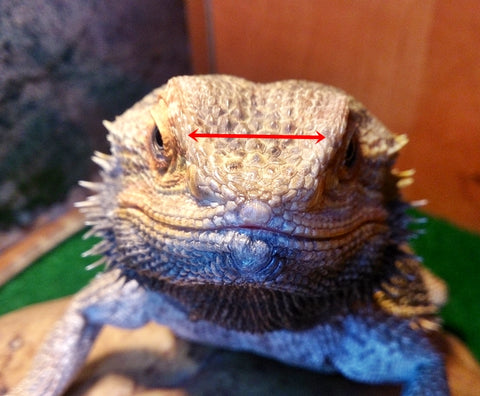
Our superworms come in 4 main sizes:
- Extra small - 1/4" - 1/2"
- Small - 1/2" - 1"
- Medium - 1" - 1.5"
- Large - 1.5" - 2"
Superworms are a natural product. Their sizes will have some variation due to the methodology to breed them. We always try to fill each order with the size that the customers order. However, superworm size variation should be expected with each order.
How Many Superworms Should I Buy?
Superworms are loaded with fat and protein - two critical nutrients for growing reptiles and amphibians. But owners should be forwarned, they have too much phosphorus and too little calcium. So please dust your superworms after you buy them with calcium. You can read the summary below, or you can read our in-depth article on how many superworms to feed your pet.
Are superworms good for chickens? - video
Chickens love superworms! Healthy chickens depend on a varied diet. And living insects such as superworms, are a great way to stimulate their prey drive. This helps keep them happy, and producing high quality eggs. Here's a video that demonstrates why chickens love superworms.
As discussed many times, superworms don't offer the recommended amount of calcium. And chickens need calcium for healthy egg development. For this reason, black soldier fly larva should always be considered for chickens.

How Many Superworms should I buy for my bearded dragon?
- Young Bearded Dragons (1-3 months old) = 10-20 <1” Superworms 3-4 times a week
- Juvenile Bearded Dragons (3-9 months old) = 5-10 1”-1.5” Superworms 3-4 times a week
- Maturing Bearded Dragons (9+ months old) = 2-3 2” Superworms twice a week
Older bearded dragons will not need as many superworms, because they are fully grown and will require a more steady diet of vegetables.
How many superworms should I buy for my veiled chameleon?
- Young Veiled Chameleons (1-3 months old) = 2-3 <1” Superworms per week
- Young Veiled Chameleons (3-6 months old) = 3-5 1” Superworms per week
- Juvenile Veiled Chameleons (6-10 months old) = 4-6 1.5” Superworms per week
- Maturing Veiled Chameleons (10+ months old) = 7-8 2” Superworms per week
*It should be noted that some Chameleons prefer superworms to all other feeder insects. However, superworms do not constitute a perfect diet on their own. Many users start with crickets in the morning and give superworms and other insects as treats in the afternoon.
How many superworms should I buy for my leopard gecko?
- Young Leopard Geckos (0-4 months old) = 6-10 <1” Superworms per day
- Juvenile Leopard Geckos (4-10 months old) = 6-10 1”-1.5” Superworms every other day
- Maturing Leopard Geckos (10+ months old) = 6-10 2” Superworms 2-3 times per week
How many superworms should I buy for my Tokay Gecko?
- Young Tokay Geckos (0-4 months old) = 6-10 <1” Superworms per day
- Juvenile Tokay Geckos (4-10 months old) = 6-10 1”-1.5” Superworms every other day
- Maturing Tokay Geckos (10+ months old) = 6-10 2” Superworms 2-3 times per week
How many superworms should I buy for my Crested Gecko?
- Young Crested Geckos (0-4 months old) = 5-8 <1” Superworms per day
- Juvenile Crested Geckos (4-10 months old) = 5-8 1”-1.5” Superworms every other day
- Maturing Crested Geckos (10+ months old) = 5-8 2” Superworms 2-3 times per week
How many superworms should I buy for my Emperor Scorpion?
- Young Emperor Scorpions (1-2 weeks) = 0 Superworms (Simply feed the Mother Scorpion*)
- Juvenile Emperor Scorpions (First molt - 5+ Inches) = 2-6 1”-1.5” Superworms every other day (outside of molting**)
- Maturing Emperor Scorpions (7-8 Inches) = 3-8 2” Superworms every other day
* Mother scorpions will tear up food to feed their young. Simply feed the mother a little extra and she will take care of her scorplings.
** When you notice the start of molting (a dull exoskeleton color), withhold all food. Wait until the new exoskeleton has hardened before feeding again.
How many superworms should I buy for my tarantulas?
- Young Tarantulas (<½”) = 1-3 <1” Superworms weekly
- Juvenile Tarantulas (First molt - 5+ Inches) = 2-4 1”-1.5” Superworms per week (outside of molting**)
- Maturing Tarantulas (7-8 Inches) = 2-5 2” Superworms weekly or bi-weekly
** Molting tarantulas should not be fed. But, directly after the exoskeleton hardens your tarantula will be very hungry. It can be offered slightly more food at this time to help it gain weight and rehydrate.
Superworm Maintenance
Receiving superworms in the mail is the easy part. Setting up a temporary habitat after you buy them can catch many customers off guard. But keeping them is easier than crickets or roaches.
Firstly, get a plastic bucket or container the size of a shoe box. Then line the bottom of the container with dry oatmeal. This will be their bedding material. And they can eat this.
Then you'll want to make sure they always have a source of moisture. This won't be a bowl of water, similar to crickets. Instead, this will be some potato slices, or some carrots. And keep an eye on their bedding material. The superworms will eat the bedding material, which is great. However, they excrete it into a sandy, fine dust. This is their poop. And just like anything, they can't live in it. So make sure you change it out periodically.
These worms are extremely active, which makes it more enjoyable for your pet, especially if they like hunting.
How to Store Superworms?
In order to completely satisfy your superworms after you purchase them, you must provide them with a suitable house. We cover the critical details in our superworms storage article. But you can see a nice summary below:
Here are important steps in ensuring your superworms have the best home possible:
- Step 1: Choose a container.
You can easily use a plastic container to house your superworms. These containers can be bought online or in stores. Another excellent container is an aquarium which can be purchased at any pet store.
Be sure that the container has smooth sides so that your superworms cannot escape. Trust me, they will try! Also, make sure the container is large enough to where there is a large amount of space even after the substrate has covered about 3 inches of the bottom of the container.
- Step 2: Provide ventilation.
Superworms need ventilation in order to survive. A mesh lid would be an excellent source of ventilation.
- Step 3: Add substrate.
Substrate refers to the material that goes on the bottom of the container. It is usually for both food and bedding for the worms that inhabit the area. In this case, it will be a source of food and bedding for your superworms.
You can use wheat bran, oats or nutritious gutload as substrate. Your superworms will love it!
Make sure to cover the bottom with enough substrate (3 to 4 inches high), to allow your superworms to burrow and wriggle around in the material.
Also, make sure the substrate you add is dry, as substrate that accumulates too much moisture can put your superworms in danger. It can eventually cause death.
Once you have your superworms home set up, you can now get to breeding your superworms! Read on to find out how to breed your superworms.
What should I feed my superworms?
Foods suitable for superworms are:
Vegetables
- Carrots
- Potatoes
- Cucumber
- Lettuce
- Radish
Fruits
- Watermelon
- Strawberries
- Grapefruit
- Pineapple
- Peaches
Just make sure their container is being routinely maintained. Any uneated foods should be removed, and replace with fresh ones. Decaying food can attract unwanted bacteria and other critters.
And if you're not a fan of the fresh fruit or vegetables, water crystals are also available to keep the enclosure moisturized. But water crystals won't gutload them vegetables or fruit.
How To Gut-Load a Superworm?
After you buy your superworms, you'll want to gut-load them. Gut-loading is when you feed them very high quality and nutritious foods in order to prepare the superworms for your reptile.
These high quality, nutritional foods will sit in the gut of your superworm. These nutritional benefits will then transfer to your bearded dragon or leopard gecko when you feed them superworms.
How To Dust Superworms With Calcium Powder
It's highly recommended that superworms get dusted with calcium powder. As noticed on our feeder insect nutritional chart, superworms have a very low amount of calcium. This is a problem for reptiles that need an adequate amount of calcium in their diet.
To increase their nutritional value, owners can dust their superworms after buying. The process is simple. Place some superworms in a bag. And add a tablespoon of calcium powder supplements. Shake the bag so that the superworms are adequately dusted with the calcium powder. Then proceed to feed the superworms to your pet.
How Can I Breed Superworms so I don't need to order them? - Tutorial Video

If you enjoy feeding your reptile superworms, it is a great idea to breed your own superworms. Continuously having to buy superworms from stores can eventually become costly. We love selling superworms, but we want you to be an amazing pet parent first and foremost.
Remember that superworms have four stages of life:
- Egg
- Larvae
- Pupae
- Beetle
This is what a pupae looks like (zophobas morio):

Only beetles are capable of reproducing superworms. This is what a zophobas morio beetle looks like:

Step 1: Choose the largest superworms in the group and place each superworm into an empty 35mm film container. If those aren’t available, you can also use:
- Bead boxes (used for crafts)
- Baby food jars
- Small bottles
Step 2: Place the superworm into the container. Do not give it any food or water.
If you add water to the container, the superworm will take longer to pupate. This is why you need to make sure you choose the largest larvae available, to lessen the amount of deaths due to no food or water. If you are just starting, then you'll want to buy the largest superworms that we sell. They are going to pupate the fastest.
After a few days, you will start to notice the superworm curling up to an “e” or “c” shape. This is where the morphing process will begin. If you notice any superworms that are straight, hard or black looking, it is likely they are dead.
The process of a superworm from larvae to pupae takes about one to two weeks.
Step 3: When the superworms finally reach the pupation state, they will resemble a cream or white colored shell. This is considered the third stage of a superworms life: The pupae stage.
Once the superworms have reached the pupal stage, it is acceptable to group them together. You can also just leave them in their individual containers, but if you are planning to start on another group of larvae, it would be beneficial to organize the pupa’s into one container.
As they go from pupae stage to beetle, you’ll start to notice a darker color on your superworms legs.
The pupae to beetle process takes about two weeks to complete.
Step 4: You’ve now reached the last stage. For your superworms who have successfully made it to the fourth step, they should now look like darkling beetles.

Before removing the beetles from their containers, make sure to construct a new breeding ground for them. A tray measured 14” x 10” x 3.5” is considered a perfect breeding container for your newly formed darkling beetles. Rubbermaid containers, cat litter pans, and Sterilite are a perfect use of breeding containers.
Layer the bottom of the container with about 1 inch of wheat bran, oats or nutritious gutload. If you use oats, make sure to blend the mixture into a powdery form, which will make it easier for you to separate, clean and feed your worms and beetles. The beetles will use this layer to lay their eggs in it.
Also, add half of an egg crate to allow a place for the beetles to gather. Doing so will prevent beetles from wandering around the enclosure and eating their eggs.
Step 5: Now that your beetles have laid their eggs, you can safely remove them from the container, and put them into a new one.
Once in their new homes, place foods such as potatoes, carrots, fruit or water crystals, into the enclosure as a sound water source. Moisture is important for both superworms and beetles alike.
If you do not keep your beetles hydrated, it can cause them to prey on other beetles, newly hatched babies, or eggs.
Step 6: About every two to four weeks, make sure to remove the beetles from the bedding and place them into a fresh container. Doing this will allow the beetles eggs to hatch, and increases the chance of your beetles being able to reproduce more often.
Your adult beetles should live up to five months so those are many eggs that have potential to be hatched. An average female beetle can lay up to 500 eggs in her lifetime.
Step 7:You now have baby superworms. Make sure to keep the temperature at about 78 degrees fahrenheit for the babies.
Add small pieces of the following foods to the container:
- Potato
- Carrot
- Apple
You may choose to use water crystals once the baby superworms get a bit older.
Breeding Tips:
In order to pupate, superworms must be separated individually.
Keep temperatures between 70 and 80 degrees fahrenheit at all times.
Make sure the container contains a good amount of moisture so that your superworms can thrive.
Change the container regularly, as superworms will eat the bedding, and then poop in it. They cannot live in their poop.
Feed beetles daily.
Superworms's Nutritional Value
| Moisture (%) | Protein (%) | Fat (%) | Fiber (%) | Calcium (g/kg) | Phosphorus (g/kg) | |
| Superworms | 58 | 47 |
42 |
8 |
1.2 |
8.3 |
| Crickets | 70 | 66 |
22 |
12 |
2.1 |
7.8 |
| Pinhead Crickets | 77 | 66 |
22 |
12 | 2.1 |
7.8 |
| Phoenix Worms | 61 | 45 |
36 |
8 |
24 |
9.2 |
| Dubia Roaches | 61 | 46 |
24 |
8 |
5.8 |
5.9 |
|
|
62 | 50 | 31 | 5.7 | 1.2 | 14.2 |
Most reptiles, including bearded dragons, leopard geckos, and chameleons will munch on superworms at any opportunity. However, it's important to know the nutritional requirements that our pets need. Many herp experts advise that carnivorous reptiles should receive the following nutrients:
- High Protein (30% - 60%)
- High in fat (40% - 70%)
- low carbohydrates and indigestible fiber
Superworms have high levels of fat and proteins, which is a necessary source for any carnivorous pet. However, their calcium-to-phosphorus ratio has more to be desired, which means it's important to dust them with calcium prior to offering them as food.
Superworms are loaded with fat content, so it is a great feeder if fed in moderation. Typically bearded dragon owners will provide them as a treat. Or, if your pet is brumating, or pregnant, then it would be an optimal time to offer more superworms. As their fat content will help your pet plump up for some brumating, or child rearing.
They are also loaded with protein which is considered a major source for the growth of reptiles and amphibians. Superworms can decrease risk of muscle atrophy and improperly working organs.
Their fiber content is lower compared to crickets, and on par with other popular feeders like black soldier fly larvae and dubia roaches. So using superworms as a routine can serve well. The only area to mindful of is their fat content. If you need more lean protein, then crickets will be a better option.
Superworms Vs Crickets - Video

| Protein | Fat | Fiber | Calcium (g/kg) | Phosphorus (g/kg) |
|
| Crickets | 66% | 22% | 12% | 2.1 | 7.8 |
| Superworms | 47% | 42% |
8% | 1.2 |
8.3 |
Based on the chart above, it's clear that both crickets and superworms provide the amount of protein that your bearded dragon needs. Crickets do offer about 18% more protein, which means they will be a better feeder for younger leopard geckos and bearded dragons. While the superworms may be better suited for older pets.
Superworms Vs Mealworms

| Protein | Fat | Fiber | Calcium (g/kg) | Phosphorus (g/kg) |
|
| Mealworms | 50% | 31% | 5.7% | 1.2 | 14.2 |
| Superworms | 47% | 42% |
8% | 1.2 |
8.3 |
Based on the chart above, it's clear why there's a better option between superworms and mealworms. Superworms are have the preferred amount of fat for your pet, while mealworms don't offer enough. Additionally, mealworms have a much worst calcium to phosphorus ratio, meaning that it's very important that they are dusted and gut loaded with calcium. Mealworms to have a solid amount of protein, but so do superworms. Based on the nutritional difference, there's really no reason to want to offer mealworms over superworms.
Superworms Vs. Dubia Roaches - Video

| Protein | Fat | Fiber | Calcium (g/kg) | Phosphorus (g/kg) |
|
| Dubia Roaches | 46% | 24% |
8% |
5.8 |
5.9 |
| Superworms | 47% | 42% |
8% | 1.2 |
8.3 |
Our in house zoologist wrote a comprehensive guide on the nutritional differences between superworms and dubia roaches
Superworms Vs. Black soldier Fly Larvae
| Protein | Fat | Fiber | Calcium (g/kg) | Phosphorus (g/kg) |
|
| BSFL |
45% | 36% |
8% |
24 | 9.2 |
| Superworms | 47% | 42% |
8% | 1.2 |
8.3 |
As we learned above, carnivorous reptiles like bearded dragons and leopard geckos require high protein and diets. And we know that the superworms worms provide both the adequate fat and protein the fat they need for energy reserves, and the protein they need to grow and heal.
But Black Soldier Fly Larvae also offer the same nutritional benefits. These amazing feeders are almost identical to superworms with protein. But they are a little more lean, with only 36% fat content. This is slightly more preferable. However, if you're bearded dragon is about to become pregnant, or about to brumate, then you might want the fattier option.
Superworms Vs. Hornworms
| Protein | Fat | Fiber | Calcium (g/kg) | Phosphorus (g/kg) |
|
| Hornworms | 58% | 20% |
9.4% |
unmeasured |
unmeasured |
| Superworms | 47% | 42% |
8% | 1.2 |
8.3 |
Hornworms are some of the most popular feeder insects for reptile owners. But they are not perfect when compared to superworms. As discussed, superworms fit into the perfect window for nutritional needs. But hornworms pack an impressive amount of protein. So for growing reptiles, hornworms will be a good consideration.
However, hornworms have a higher fiber content, and unmeasured minerals. This means your pet will have a harder time digesting them compared to superworms, but their minerals are unknown. Which makes them slightly risky as a staple feeder. You can find more details in our guide that compares superworms and hornworms.