


A water-and-air-filled kettlebell trainer that makes familiar carries, get-ups, and swings more demanding for the shoulder and trunk — without requiring heavy loads.
The KHAOS® Waterbell is a water-and-air-filled kettlebell trainer that makes familiar kettlebell patterns — like light swings, waiter’s carries, Turkish get-ups, and bottom-up holds — more demanding for the shoulder and trunk without requiring heavy loads. Instead of a fixed block of iron under the handle, the internal water shifts as the athlete moves, creating small, continuous disturbances that the shoulder, wrist, and core have to manage together.
- Shifting Center of Mass — Water sloshes and shifts independent of the handle, forcing the athlete to stabilize against motion rather than a fixed block — something a cast-iron kettlebell can never replicate.
- Inverse Volume Principle — Less water with more air creates a lighter, faster-moving payload; more water produces a heavier, more settled feel. Coaches tune the chaos-to-load ratio for each athlete and goal.
- Overhead Joint-Centration Emphasis — Any lean or drift during waiter’s carries or Turkish get-ups causes the water to surge toward the tilt, forcing the rotator cuff and shoulder-blade muscles to fire reflexively.
- Anti-Lateral & Anti-Rotational Core Demand — Sloshing water amplifies the tipping effect of unilateral carries, teaching the obliques (side abdominal muscles), quadratus lumborum (lateral spine stabilizer), and transverse abdominis (deep abdominal compressor) to brace in real time.
- Soft, Impact-Friendly Shell — Flexible, heavy-duty clear PVC body gives the forearm a more forgiving contact surface, making high-velocity patterns and overhead carries accessible for a wider range of athletes.
- Compact, Adjustable Load Range — Water capacity of about 10 lb, plus an option to add a small plate between the handle and bladder for extra resistance, covers rehab-friendly to shoulder-centric conditioning without a full kettlebell rack.
What Is It?
The KHAOS® Waterbell is a water-and-air-filled kettlebell-style implement with a rigid handle on top and a flexible, clear PVC body below that holds the fluid. The athlete fills the body with water up to approximately 10 lb, then adds air to adjust both how heavy and how reactive the load feels. No two reps produce exactly the same balance demand.
Compared to a traditional kettlebell, which behaves like a predictable, solid weight, the Waterbell’s moving payload means the wrist, shoulder, and trunk have to adjust on every rep, even when the pattern is familiar. Compared to larger KHAOS® water tools like the Water Ball or Waterboy, the Waterbell’s grip and profile keep it in the kettlebell family — a natural fit for get-ups, carries, and other single-arm overhead patterns.
How It Works
Three mechanisms behind the shifting water load
Perturbation-Induced Joint Centration
During overhead positions like waiter’s carries and get-ups, any lean causes the water to surge toward the tilt, forcing the rotator cuff to fire rapidly to keep the humeral head centered in the socket — a demand that repeats on every step and every position change.
Scapulothoracic Integration
Holding the Waterbell overhead during lunges or get-ups prevents the shoulder blade from settling into a passive position. The serratus anterior and lower trapezius must keep working to maintain smooth shoulder-blade motion against the constantly changing fluid load.
Proprioceptive Co-Contraction
Erratic water feedback continuously stimulates position sensors in the wrist, elbow, and shoulder, sharpening joint awareness. Because muscles on both sides of the joint must fire together to keep the Waterbell under control, the tool promotes balanced co-contraction (simultaneous firing of opposing muscles) without heavy absolute loads.
Backed by Research
The Science of Overhead Shoulder Stability
There is no single peer-reviewed trial on the KHAOS® Waterbell itself; support comes from broader work on unstable resistance, perturbation-based joint centration, and overhead stability training, combined with field use in overhead-athlete programs. Research supports perturbation-based and unstable-resistance training for improvements in neuromuscular control and shoulder stabilizer recruitment in overhead athletes.
Video Library
See It In Action
Click the thumbnail to play from the start — click any timestamp to jump to that moment.
2025
This Water-Filled Kettlebell Creates CONTROLLED CHAOS! 🌊💪
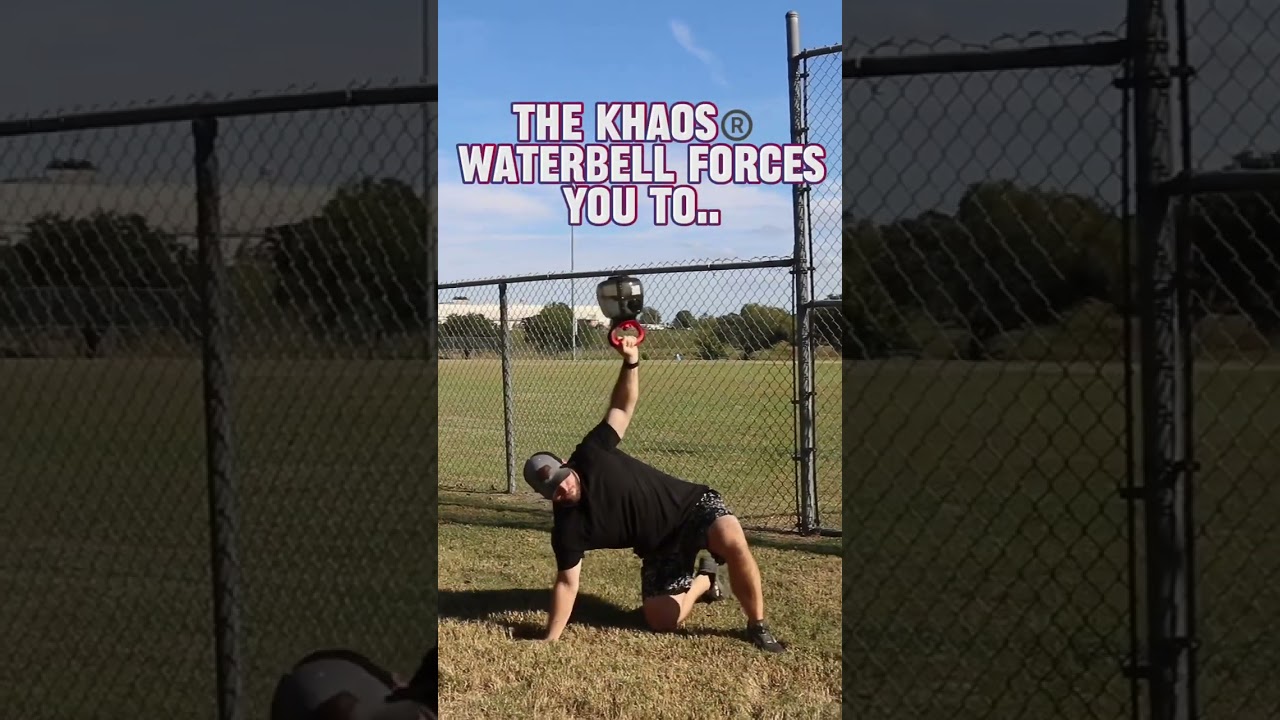
| Overhead single-arm Waiter's Carry — fluid slosh as the athlete walks forward. | |
| Turkish Get-Up, floor-to-kneeling — overhead fluid requires continuous forearm micro-adjustments. | |
| Standing phase of the Turkish Get-Up — complete shoulder girdle stabilization under the moving load. | |
| Front-rack positioning — close-up of water shifting inside the clear vinyl shell. | |
| Overhead walking lunge — fluid side-to-side slosh during lower-body movement. | |
| Return to ground phase of Turkish Get-Up — eccentric shoulder control and deep joint stabilization. |
Product Details
How to Use It
Waiter’s carries and overhead holds: Single-arm waiter’s carries penalize any lean or sloppy wrist position. Emphasize a stacked wrist, elbow, and shoulder over a tall, quiet torso. Start with shorter distances before progressing.
Turkish get-ups: Start with partial patterns (floor to kneeling, kneeling to standing) before full reps. Move slowly enough to feel the water shift and keep the shoulder centered.
Overhead lunges: Overhead or front-rack walking lunges blend lower-body strength with overhead shoulder organization. Focus on clean step length, upright torso, and quiet front knee while the upper body manages the shifting load.
Pre-throw and post-throw: Before throwing, light fills and slow patterns activate shoulder stabilizers. After throwing, lower-intensity overhead holds promote co-contraction (simultaneous muscle firing on both sides of the joint) without heavy arm stress.
Load Selection Guide
The KHAOS® Waterbell is a single size; all customization comes from water fill level and the optional plate add.
| Load Setup | Effect & Use |
|---|---|
| Light fill + max air | Fast, high-velocity slosh — maximum reactive demand; best for joint-control training and warm-up |
| Moderate fill | Balanced slosh and load — practical starting point for most athletes; recommended entry |
| Near-full water (~10 lb) | Slower slosh, higher load — behaves more like a traditional implement; strength emphasis |
| + Small plate add | Extra resistance beyond 10 lb via plate between handle and bladder — advanced use only |
Start well below full capacity. Reserve heavier fills and the plate add for later progressions after clean control is confirmed.
Who This Is For
- Commonly used for baseball and softball pitchers and position players who need better overhead shoulder control and trunk organization.
- Commonly used for overhead athletes in volleyball, tennis, and swimming who need shoulder stability in tall, arm-up positions.
- Commonly used by strength and conditioning staffs who want a compact, water-based alternative to traditional kettlebells for carries, get-ups, and shoulder-focused instability work.
- Commonly used for older youth athletes and return-to-play contexts where overhead stability and coordination matter more than heavy load.
We are not coaches.
What This Implement Does NOT Do
- It does not replace foundational strength work; it is one instability-focused tool within a broader program.
- It does not guarantee velocity or performance gains on its own; outcomes depend on overall program design and recovery habits.
- It does not teach throwing or swing mechanics by itself; athletes still need specific skill coaching for those patterns.
- Not designed for high-impact ground slams or uncontrolled swings against hard surfaces.
Technical Specs
| Product Name | KHAOS® Waterbell |
|---|---|
| SKU | KWB |
| UPC | 608938931351 |
| Also Known As | Water Kettle Bell, Shoulder Stability Trainer, Waiter Carry Device |
| Max Water Capacity | ~10 lb of water |
| Empty Weight | ~18 oz before filling |
| Additional Load | Small plate between handle and bladder adds resistance beyond ~10 lb |
| Training Focus | Overhead joint centration, scapular integration, anti-lateral/anti-rotational trunk bracing, proprioceptive control |
| Environment | Clear spaces with appropriate flooring; bullpens, weight rooms, warm-up areas |
Safety and Youth Guardrails
Designed for athletes roughly 13 and older under coach or qualified adult supervision. For younger or growth-window athletes, use light loads, simple patterns, and clean movement quality. Stop immediately on sharp pain, loss of normal control, or unusual symptoms.
Growth-window guidance: Use conservative fills during rapid growth; watch for soreness at growth plates or tendon sites as bone adaptation can outpace soft tissue.
- Not a toy: A training implement for supervised athlete and coach use only.
- Not for uncontrolled impact use: Not built for high-speed ground slams or strikes against hard surfaces.
- Rehabilitation use only under supervision: Loading and patterns in rehab contexts should be introduced by or coordinated with a qualified medical or rehab professional.
Frequently Asked Questions
How much water should I start with?
Many coaches start well below full capacity so the Waterbell is easy to control while still producing noticeable slosh, then gradually increase volume as athletes demonstrate clean control and solid recovery.
How is this different from a regular kettlebell?
A standard kettlebell is a solid, predictable mass. The Waterbell’s water moves continuously — every rep produces a slightly different stability demand for the wrist, shoulder, and trunk.
When should I choose the Waterbell instead of other KHAOS® water products?
Choose the Waterbell for single-hand overhead patterns — carries, get-ups, and holds. Choose the Water Ball, Waterboy, or Bulgarian Water Bag for larger rotational and two-hand drills.
Can a small plate be added for more resistance?
Yes — a small plate between the handle assembly and bladder adds resistance beyond the ~10 lb water capacity. Establish clean overhead control at lighter fills first before adding plate weight.
Can the Waterbell be used around throwing sessions?
Yes. It is often used before throwing to activate shoulder stabilizers and core control with light fills, and after throwing for low-load, co-contraction-focused patterns — as long as volume and intensity are matched to the athlete’s overall workload.
Is the Waterbell appropriate for youth athletes?
Yes, for athletes roughly 13 and older using light fills, simple patterns, and close coaching — focus on clean overhead control, not heavy loading.
Questions before you buy? Call or Text Our Team at (936) 295-4459