


A backpack harness that mounts a Khaos® Water Ball to the upper back — so every cut, jump, field, and swing happens with a shifting water payload riding along.
The KHAOS® Cradle is a backpack-style harness that securely mounts a KHAOS® Water Ball to the upper back or chest, so the shifting water weight trains core control, footwork, and sport-speed movement without tying up the hands. By moving the unstable resistance off a single handgrip and onto the torso, it lets athletes sprint, jump, field, swing, and throw with a moving water payload riding along every change of direction.
(Top-down instability here means the moving resistance enters from above the feet and challenges how the body controls its center over the ground, instead of being pushed or pulled from the hands.)
- Backpack Harness for Top-Down Instability — A central mesh housing holds the KHAOS® Water Ball snugly against the upper-mid back, over the thoracic spine (upper-back region of the spine), challenging the spine and hips to stay organized while the athlete moves freely.
- Shifting Water Instead of Fixed Vest Resistance — The water lags behind cuts, jumps, and rotations, then crashes into the ball’s walls — forcing deep trunk muscles to react to delayed impacts a weighted vest never creates.
- Hands-Free for Sport-Specific Drills — Weight is strapped to the torso, not held in the hands. Athletes can carry balls, bats, gloves, and other implements while the moving water amplifies any balance or posture leaks.
- Adjustable Fit for Secure, Centered Loading — Heavy-duty webbing, shoulder straps, and a sternum strap keep the ball centered between the shoulder blades so instability stays in the water, not in the harness position.
- Integrated with KHAOS® Water Ball MAX — Built to house the 30 cm Water Ball MAX; coaches tune the load from lighter movement-quality work (10 lb) to more demanding stability sessions (up to ~35 lb) by adjusting water volume and air pressure.
- Whole-Body Demand with Lower Joint Impact — Moving water forces the trunk, hips, knees, and ankles to control shifting forces while total weight stays modest compared to heavy metal plates.
What Is It?
The KHAOS® Cradle is a custom-designed backpack harness that holds a partially filled KHAOS® Water Ball against the upper back or chest using a secure mesh sleeve and adjustable straps. Once mounted, the water ball and harness move with the athlete’s torso, turning everyday ladder work, shuttles, jumps, and rotational drills into an active stability challenge.
Compared to standard weighted vests or backpacks, which behave like fixed blocks of weight, the Cradle uses water that lags and then crashes into the ball’s walls with each movement change. Compared to holding a water ball in the hands, the Cradle frees the arms for catching, throwing, swinging, and handling additional implements while the unstable weight rides on the trunk.
How It Works
Three mechanisms behind top-down water resistance
Center-of-Mass Shifts
When the athlete plants to cut, the fluid crashes into the side of the ball, shifting the body’s center of mass (where the weight is balanced over the feet) and forcing the hips, knees, and ankles to stabilize quickly against sideways forces — a two-stage disturbance a fixed vest never produces.
Trunk Alignment & Energy-Leak Reduction
Mounting the ball over the thoracic spine asks the transverse abdominis (corset-like muscle wrapping the midsection) and the multifidus (small stabilizers along the spine) to fire reflexively to keep the spine neutral — limiting energy leaks through the midsection during explosive movements.
Whole-Body Proprioception
The unpredictable water shift challenges proprioception — the body’s ability to sense joint position and adjust automatically — in the feet, legs, and spine on every rep, teaching fast automatic corrections without heavy compressive joint load.
Backed by Research
The Science of Hands-Free Top-Down Instability
There is no single peer-reviewed study on the KHAOS® Cradle itself; support comes from broader work on unstable load training, perturbation-based balance, and proprioceptive drills for whole-body stability. Research supports perturbation-based and unstable-resistance training for improvements in neuromuscular control and dynamic stability in athletic populations.
Video Library
See It In Action
Click the thumbnail to play from the start — click any timestamp to jump to that moment.
2022
KHAOS® Cradle — Revolutionize Your Training
| Agility Mini-Hurdle Progression — lateral high-knees while managing vertical bouncing slosh of the rear-mounted water load. | |
| Ladder Footwork Drills — quick-feet variations where direction changes cause lateral fluid shifts, forcing the core to stabilize. | |
| Overhead Tracking — long-lever oscillation device worn with the Cradle to challenge upper-body stability and lower-half tracking simultaneously. | |
| Dynamic Single-Leg Launch — bounding leaps building explosive lower-half power while managing unexpected water payload movement on landing. | |
| Sport-Specific Agility Shuttles — rapid defensive backpedals and change-of-direction sprints simulating live game reactions. | |
| Ground-Object Pickups — active squatting and lunging with an additional handheld ball while keeping the harness stable. | |
| Structural Lunging & Rotational Med-Ball Press — lower-body strength work integrated with upper-extremity pressing mechanics. | |
| Baseball Fielding Mechanics — glove-side approach and high-intent release path with the harness keeping the torso stable on the approach. | |
| Bullpen Prep — dry pitching deliveries and throws into a target pad to groove consistent torso acceleration and front-side deceleration. | |
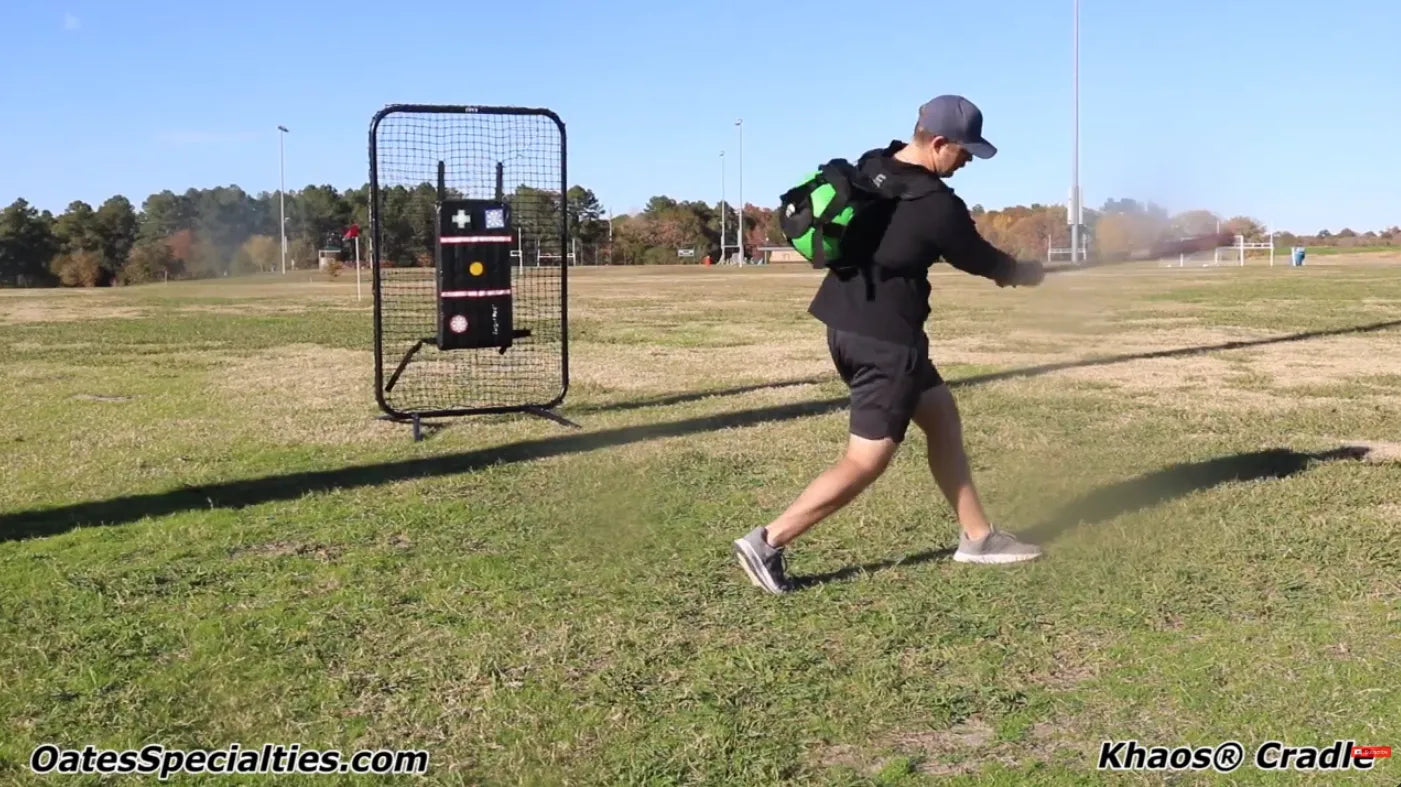
| Hitting Simulation — full rotational bat swings training the obliques and hips to control the shifting load through contact. | |
| Full-Body Rotational Chops — heavy med-ball side-to-side pattern maximizing rotational trunk bracing while wearing the harness. |
Product Details
How to Use It
Agility ladders and mini-hurdles: Lateral high-knees, quick-feet ladders, and short-space shuttles — each cut makes the water surge. Keep the torso tall and foot contacts clean to absorb the delayed crash without collapsing at the hips or spine.
Single-leg jumps and power bounds: Landing forces meet a moving water weight on the back. Watch for knee cave-in, forward trunk dive, or excessive wobble; coach toward stacked joints and quiet landings.
Baseball fielding, throwing, and hitting rehearsals: Field ground-ball or fly-ball simulations with the harness on — the water’s movement highlights sloppy torso control on the approach. During dry swings or tee work, the rotating trunk manages the shifting ball through contact, training the obliques and hips to drive the motion instead of muscling it with the arms.
Conditioning circuits and med-ball work: Lunges, squats, and rotational med-ball presses or chops with the Cradle on — the core controls both the med ball and the moving water. Limit intervals at first; build complexity as athletes show stable posture and good next-day response.
Variant & Fill Selection Guide
The KHAOS® Cradle is a single system designed to work with the 30 cm KHAOS® Water Ball MAX (HKBGC). All customization comes from water volume and air pressure in the ball.
| Fill Level | Effect & Best For |
|---|---|
| ~10–15 lb | Light, reactive — maximum slosh feedback; starting point for most athletes and youth |
| ~20–25 lb | Moderate — balanced load and reactivity; practical working range for high-school and college athletes |
| ~30–35 lb | Heavier — strength-emphasis sessions for advanced athletes showing clean control at lighter fills |
One-size-fits-most. Start moderate; progress only as athletes show clean movement and strong next-day response.
Who This Is For
- Commonly used for baseball position players who need better torso control during fielding, cutting, and change-of-direction patterns.
- Commonly used for hitters and pitchers who want to feel a more connected trunk-driven rotation during dry swings and throwing progressions.
- Commonly used for multi-sport athletes (football, soccer, basketball, lacrosse) who rely on reactive agility and balance under unpredictable forces.
- Commonly used by strength and conditioning staffs building circuits that blend conditioning, trunk organization, and sport-specific movement.
We are not coaches.
What This Implement Does NOT Do
- It does not replace foundational strength training or sport-specific skill work; it is one instability-focused tool inside a broader program.
- It does not guarantee speed, power, or performance gains on its own; results depend on overall training design and recovery.
- It does not turn poor movement into good movement automatically; athletes still need clear coaching on technique and posture.
- It is not designed for water sports or swimming; it is intended for use on dry land with appropriate footing and clearance.
Technical Specs
| Product Name | KHAOS® Cradle |
|---|---|
| SKU | HKBGC |
| UPC | Not yet assigned — add once created in catalog |
| Also Known As | Water Backpack, Wearable Water Trainer, Top-Down Instability Trainer |
| Ball Compatibility | 30 cm KHAOS® Water Ball MAX only |
| Max Water Capacity | ~35 lb via included Water Ball MAX |
| Working Range | ~10–35 lb, adjusted by athlete size and session goal |
| Harness Weight (Empty) | ~3 lb |
| Harness Materials | Heavy-duty nylon webbing; central mesh ball housing; adjustable shoulder and sternum straps |
| Training Focus | Core bracing, center-of-mass control, rotational sequencing, change-of-direction control |
| Environment | Dry-land only — clear spaces with non-slip footing and no obstacles in the movement path |
Safety and Youth Guardrails
The KHAOS® Cradle is intended for athletes roughly 13 years and older training under coach or qualified adult supervision. For growth-window athletes, prioritize movement quality and conservative fill levels rather than maximum load. Stop immediately on sharp pain, dizziness, or loss of normal control.
Growth-window guidance: Conservative fills and limited volume during rapid growth; watch for soreness at growth plates or tendon attachment sites as bone adaptation can outpace soft tissue.
- Not a flotation device: Not designed for water safety or swimming use.
- Not for impact or contact hitting: The harness and ball should not be used for tackling drills or as a contact surface.
- Rehabilitation use only under supervision: In rehab settings, fill level and drill choice should be guided by a medical or rehab professional.
Frequently Asked Questions
What size Water Ball does the Cradle use?
The Cradle is built to hold the 30 cm KHAOS® Water Ball MAX, which can be partially filled to set the total weight for the session.
How tight should the harness be?
Snug enough that the ball stays centered between the shoulder blades and moves with the torso, without pinching or restricting normal breathing and arm motion. If the ball shifts around in the housing during drills, tighten the shoulder and sternum straps.
Is this only for baseball?
No. While many examples feature baseball movements, the Cradle works with any field or court sport that relies on cutting, jumping, and rotational power — football, soccer, basketball, lacrosse, and more.
How heavy should I fill the ball?
Start with moderate fills (roughly 10–15 lb) that let the athlete maintain stable posture and clean footwork, then gradually increase water volume only as they demonstrate control and strong next-day response.
Is this appropriate for youth athletes?
Yes, for athletes roughly 13 and older under supervision, using conservative loads and simple drills. Younger or smaller athletes should use lighter fills and shorter bouts, consistent with the 13+ guideline used across the Khaos® product line.
Questions before you buy? Call or Text Our Team at (936) 295-4459